You have started watching the ground instead of where you are going, and the stairs get taken one at a time with a hand on the rail. Balance therapy trains the systems that keep you upright, and the strength to catch yourself when one of them slips.

Standing upright feels automatic right up until it stops feeling automatic. Three systems do that job. Your eyes tell you where the horizon is. Your inner ear tells you which way your head is tilted and how fast it is moving. The nerves in your feet and ankles tell you what the ground is doing underneath you. Your brain compares all three, and while they agree, you never think about it. When one starts under-reporting, whether from age, nerve changes in the feet, an inner ear problem, a replaced joint, or simply months of moving less than you used to, the other two have to cover for it and the margin for error gets thin. Balance therapy is the physical therapy that retrains those systems on purpose. A Doctor of Physical Therapy tests each one separately to find which is falling behind, then loads it deliberately with surfaces that change, head turns while walking, and vision reduced or removed.
Alongside that, we rebuild the hip and ankle strength that decides whether a stumble ends in a quick step or on the floor. Confidence is part of the treatment, not a side effect. People who feel unsteady walk less, walking less makes the unsteadiness worse, and that loop tightens quietly over a year or two. Breaking it is often the most valuable thing that happens here. The goal is not just fewer wobbles. It is being willing to go to the store, the beach and the family gathering without doing the math first.

Balance therapy is for anyone whose footing has stopped feeling reliable, whether or not you have fallen yet. Waiting for a fall to prove the point is the one thing we would ask you not to do.
Maybe you caught yourself on the counter. Maybe you did not, and now you replay it every time you cross the kitchen. We find which system let you down and train it, then rebuild the hip and ankle strength that turns a stumble into a recovered step instead of a landing.
Grass, gravel, a dim hallway, a curb you did not see coming. When your eyes cannot do all the work, the gaps in the other two systems show up immediately. We train on the surfaces and in the conditions that actually catch you out, so your feet and inner ear carry their share again.
You know the route through your own house by which piece of furniture you reach for next, and you have started declining anything that involves walking on unfamiliar ground. We build tolerance back one step at a time so your world stops shrinking around your balance.
Balance gets measured here, not described. We accept Aetna, ASHLink, Blue Cross Blue Shield, Cigna, Fallon Health, Harvard Pilgrim, Mass General Brigham Health Plan, Medicare and Tricare, along with Workers' Compensation and auto injury claims, and we verify your benefits and give you your copay in writing before your first visit.
Your first visit puts numbers to the problem. We watch you stand with your feet together and your eyes closed, walk while turning your head, step over and around obstacles, and rise from a chair without using your hands. Each task leans on a different system, so the pattern of what fails tells us where the work belongs. You can start physical therapy in Massachusetts without a physician referral, though some plans still require one for coverage, and we check that for you first.
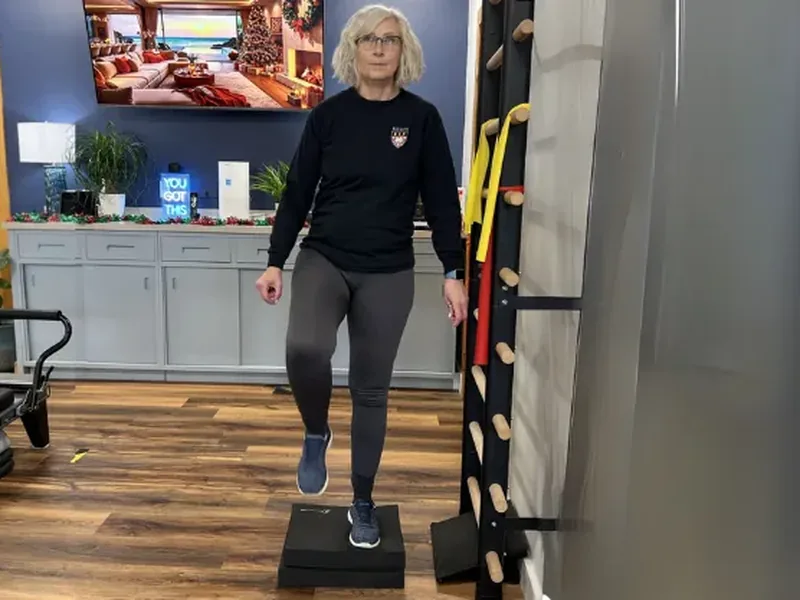
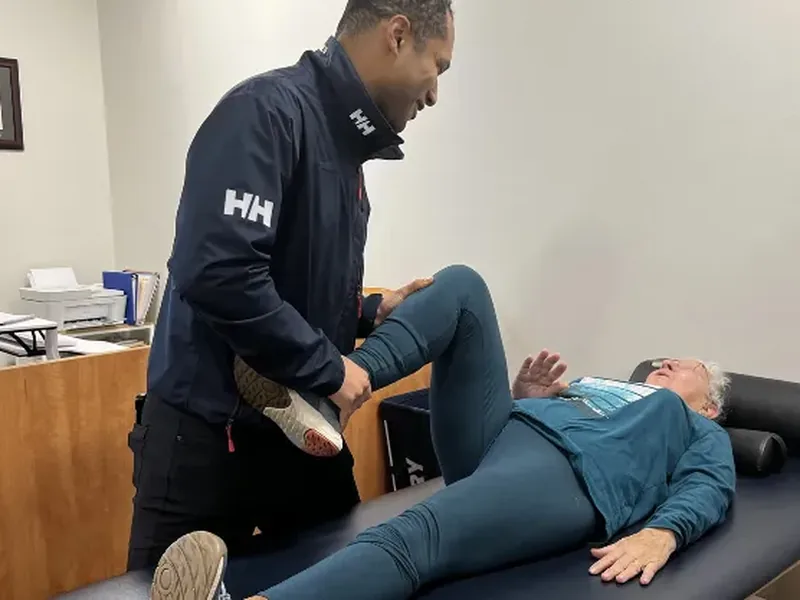
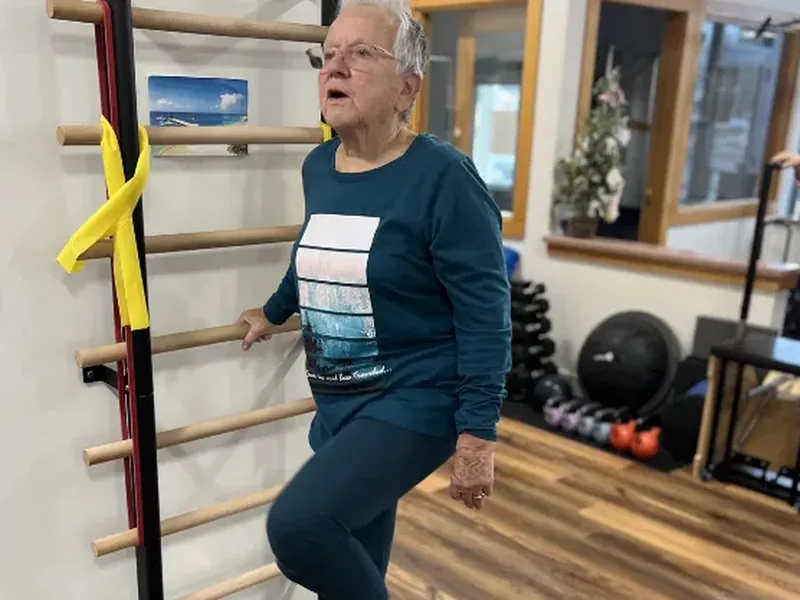
Then we train whichever system came up short. Surfaces that give underfoot, head movement while you walk, vision reduced or taken away, reaching outside your base of support. Every drill happens within arm's reach of your therapist and next to a rail or a wall. Sessions run 30 to 60 minutes, one on one with your doctor of physical therapy, so nobody is challenging their balance while attention is somewhere across the room.
Balance without strength is a reflex with nothing behind it, so every session includes real work for the hips, ankles and legs that have to fire when you catch yourself. You leave with a short home program and specific suggestions for the rooms and thresholds that give you trouble. Most patients notice improvement within about six visits, and typical care runs two to three visits a week for four to six weeks.
Balance training only works if it challenges you, and challenge carries a real risk of a stumble. Every drill is done with your therapist within arm's reach and a rail, wall or gait belt available, and we stop short of tasks you are not ready for rather than pushing through them. Tell us about any fall or near fall, fainting, lightheadedness on standing, new medication, or change in vision, because those change what is safe to train that day. Unsteadiness that arrives with chest pain, sudden weakness, slurred speech or new confusion needs medical review before physical therapy.
I am so thankful to have walked through the doors at Maritime...I was in a bad place with severe balance issues and pain. Dr. Mulligan has restored my range of motion and my confidence.

The condition page. Why footing and walking pattern change, and how we assess both.

For when the inner ear is the system under-reporting and dizziness comes with the unsteadiness.

Strength, balance and independence for older adults, built around the goals you name.