Three people have told you to strengthen your core and none of them watched you do it. Pilates in Plymouth builds the deep control underneath that advice, on a reformer, one on one with a doctor of physical therapy.

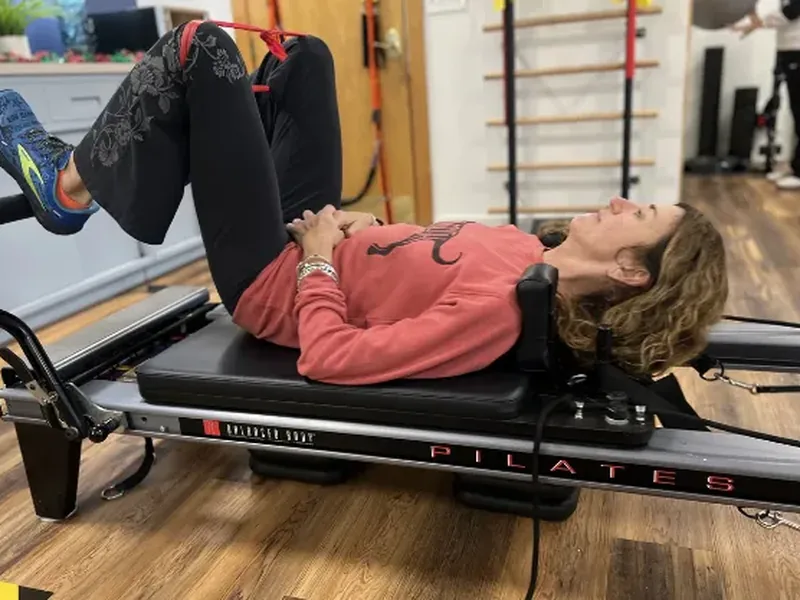
Pilates is a system of low-impact, precisely controlled exercise built around breathing, alignment and the deep muscles that steady your spine, pelvis and shoulders. On a reformer, a sliding carriage with adjustable spring resistance, that work becomes measurable. Springs can be lightened so a movement is possible when you are sore or newly out of a sling, or loaded so the same movement is genuinely hard. The carriage also gives feedback a mat cannot. If your pelvis shifts or one leg is quietly doing more than the other, you feel it the moment it happens. Pilates-based exercise is one of Maritime Physical Therapy's three stated specialties, alongside manual therapy and functional dry needling, and Dr. Brittney Mulligan is a certified Pilates Reformer I teacher through Balanced Body. That matters, because Pilates in a clinic is not a class. Exercises are chosen from your assessment findings, your springs are set for your capacity, and the work sits inside a rehabilitation plan rather than running off a playlist.
You do not need a physician referral to begin. Massachusetts has direct access to physical therapy, so you can book an evaluation with us directly. Some insurance plans still require a referral for coverage, so we verify your benefits before your first visit and tell you in writing what is covered and what your copay will be. We accept Aetna, ASHLink, Blue Cross Blue Shield, Cigna, Fallon Health, Harvard Pilgrim, Mass General Brigham Health Plan, Medicare and Tricare, along with Workers' Compensation and auto injury claims. Flat self-pay rates are available if you are not covered.
You do not need to be flexible, athletic or already fit to start. The reformer adapts to you, not the other way around. These are the people who get the most out of it.
You have had the same episode three or four times, and you spend the good weeks bracing for the next one. Reformer work rebuilds the deep control that keeps your spine steady while you bend, lift and twist through a normal day. Outcome: you get through a week of ordinary life without negotiating with your back.
The pain has settled, your visits are winding down, and you know exactly what happens if the work stops. Pilates gives that work a structure and a progression instead of a folded handout in a kitchen drawer. Outcome: you keep the strength and mobility you spent weeks earning, and the old problem stops resurfacing.
You are strong in a straight line and fall apart the moment the movement gets asymmetrical or the pace changes. Pilates trains the positions and the control that show up in the last mile of a run or the last set of a session. Outcome: cleaner mechanics, better balance side to side, and fewer of the small injuries that come from compensating.
Sessions run 30 to 60 minutes, one on one with your doctor of physical therapy. No group class, no waiting your turn on a machine.
Before you get on the reformer, your therapist watches you move: how your spine segments, how your hips and shoulders behave under load, where you compensate, and what provokes your symptoms. That assessment decides which exercises you start with, which spring settings you use, and which movements stay off the list for now. Nothing is included because it looks impressive.
You work through a sequence chosen for your findings while your therapist adjusts spring tension, foot position and tempo as you go. The cues are specific and the corrections happen in the moment, which is the entire reason to do this one on one. Expect it to feel like concentration rather than exhaustion. Deep control is quiet work, and it is harder than it looks.
Springs get lighter or heavier, your base of support narrows, and the exercises move toward the things you actually do outside the clinic. You leave with a short home sequence and a clear picture of what changes next. Most patients notice improvement within about six visits, and a typical plan of care runs two to three visits a week for four to six weeks.
Wear fitted clothing you can move in, and grippy socks or bare feet. Tell us before your first session about any recent surgery, a current or recent pregnancy, osteoporosis, or a diagnosed spinal condition. None of those rules Pilates out, but each one changes which exercises and which spring settings are appropriate, and your therapist needs to know that before you get on the reformer rather than after.
Very knowledgeable Physical Therapists in a comfortable atmosphere. Alana is wonderful and very experienced.

Prescribed, progressive exercise aimed at the exact deficits your evaluation turned up.

Return to sport programs built around your sport, your position and your timeline.

The most common reason people find us, and a common reason people start reformer work.