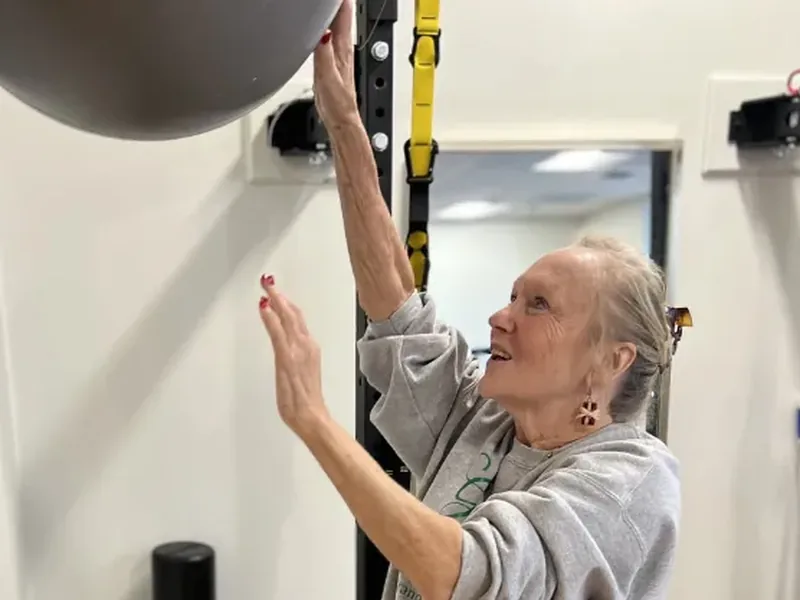
The joint moves, but it does not glide, and every rep stops at the same wall. Graded hands-on mobilization gives back the accessory motion that stretching cannot reach.

You can feel it at the same point every time. The shoulder rises to a certain height and stops. The ankle bends so far and meets a wall. Joint mobilization is skilled, graded passive movement applied directly to that joint to restore the small gliding motions it has quietly lost. Every joint has two kinds of movement. There is the motion you produce yourself, like lifting your arm, and there is accessory motion, the tiny slide, roll and spin between the joint surfaces that has to happen underneath for the visible motion to be free. When the capsule and the connective tissue around a joint tighten after an injury, a surgery, or months of guarding, the accessory motion is what goes first. Your therapist stabilises one side of the joint, takes the other to the exact edge of its available range, and applies a controlled oscillation or a sustained hold at a chosen grade of pressure. It is slow, measured, and kept inside your tolerance. There is no thrust and no pop. The goal is a joint that travels its full arc again, so the strengthening work that follows has somewhere to go.
Mobilization on its own is a door, not a destination. Range you open and then never use is how the stiffness comes back by the following week, which is why every mobilization here is followed immediately by movement that asks you to own the new range under your own power. Massachusetts direct access means you can book that evaluation without a physician referral. Some plans still require one for coverage, so we verify your benefits before your first visit and tell you exactly where you stand.
This is for stiffness with a clear mechanical edge to it: a joint that has stopped moving the way it used to and will not be argued out of it by stretching. If your range ends abruptly at the same place every single time, an evaluation is worth the hour.
You reached into the back seat, something caught, and weeks later the arm still stalls near shoulder height. Nothing is torn. The capsule has tightened and the joint has stopped gliding underneath the motion you are asking for. Graded mobilization gives that glide back a few degrees at a time, until reaching the top shelf no longer means hiking your whole shoulder up to get there.
Months after the sprain the swelling is long gone, but the ankle will not bend forward under your body weight. So your knee cuts the step short, your hip picks up the slack, and now your back is the thing complaining. Mobilizing the ankle back into its glide restores that forward bend, and the pattern above it usually settles once the joint stops blocking.
Backing out of the driveway means turning your shoulders because your head will not go. The muscles get blamed and massaged, but the restriction often sits in the small facet joints that let each vertebra slide on the one below. Gentle mobilization at the segment that is actually stuck restores rotation, and the blind spot stops being a two step maneuver.
This is quiet, unhurried work, applied at a grade you can tolerate and reassessed constantly. Here is how a session runs from the moment you walk in.
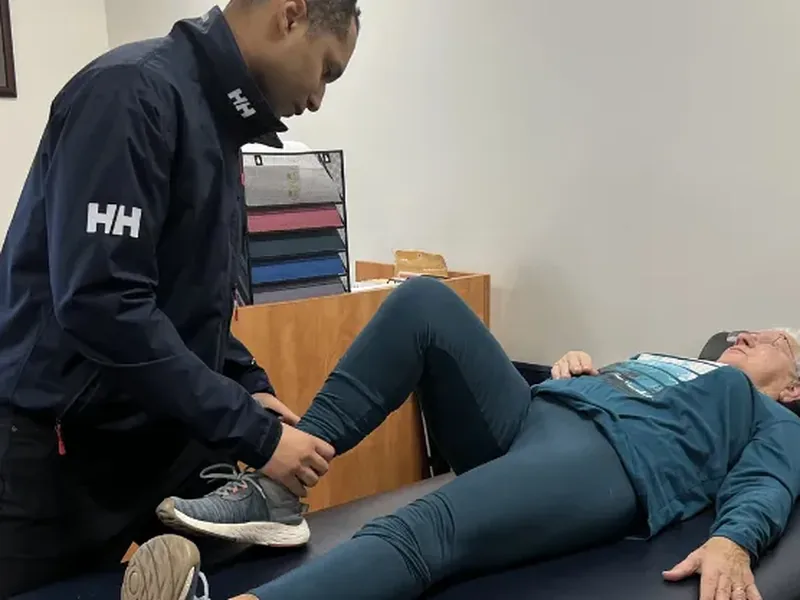
Your first visit is a full hands-on evaluation, 30 to 60 minutes one on one with a Doctor of Physical Therapy rather than shared with three other patients. Your therapist measures your range, then moves the joint passively to feel where the motion ends and what kind of ending it has. A hard, abrupt stop points at the joint itself. A springy one points at muscle. That distinction decides whether mobilization is the right tool for you at all.
You are positioned so the joint is relaxed and fully supported. Your therapist stabilises one bone and moves the other in the one direction that is restricted, either as a slow rhythmic oscillation or as a sustained hold. The pressure is graded, and the grade is chosen for what your tissue can take that day. You should feel stretch and pressure and nothing sharp. Say so the moment that changes, and your therapist backs the grade off.
New range that goes unused closes back down, so the last part of every session puts you in the range you just gained under your own control, with a short home program to repeat between visits. Most patients notice improvement within about six visits, and typical care runs two to three visits a week for four to six weeks. We accept nine major carriers including Blue Cross Blue Shield and Medicare, plus Workers' Compensation and auto injury claims, and self-pay rates are available.
Joint mobilization is not appropriate for everyone. Tell your therapist about osteoporosis, active inflammatory arthritis, a recent fracture, a joint replacement, long-term steroid use, cancer, or any blood thinner you take, and about dizziness that comes on with neck movement. Pressure, stretch, and mild soreness for a day afterward are normal. Sharp pain, numbness, pins and needles, or dizziness during the technique are not. Tell your therapist to stop the moment you feel any of them, and the technique changes or ends there.
My experience was very positive. Jake was very focused on developing a treatment plan for my lower back, that addressed my PT needs both at the clinic and home. The results were fantastic!

The wider hands-on toolkit that joint mobilization belongs to, including soft tissue work and manipulation.

Where restored joint range gets rebuilt into strength for your sport, your position, and your timeline.

The most common reason people find us, and a frequent home for graded spinal joint work.