An hour on a spa table feels good and wears off by Tuesday. Clinical massage goes after the tissue actually driving the pain, inside a plan that has a finish line.

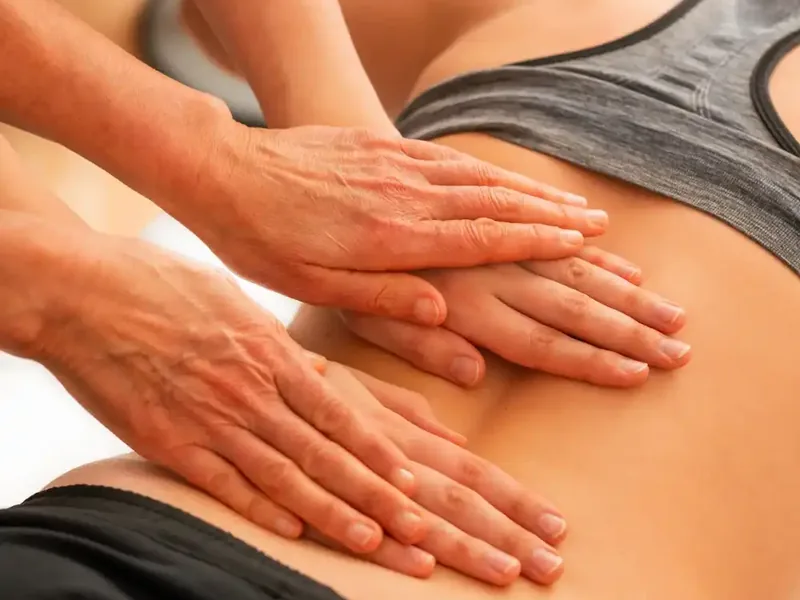
Massage inside a physical therapy plan is a different thing from an hour of relaxation, and the difference is the target. A spa massage is generalised and works the whole back because the whole back is there. Clinical massage is aimed. Your therapist has already examined how you move, found the tissue that reproduces your symptom, and chosen the region, the depth and the direction accordingly. The techniques overlap: long warming strokes to assess, kneading and compression into a muscle belly, sustained pressure into a tender point, slower work into fascia where the layers have stopped sliding. What changes is why each one is chosen and what happens afterward. Massage reduces muscle tone and pain sensitivity and brings circulation to the area, which makes it excellent preparation for movement and a poor substitute for it. So the table work is the first half of the session, not the whole of it.
That is also why massage here is never sold by the hour on its own. It is one part of a plan with a beginning and an end, and your therapist will tell you when the tissue no longer needs it. Massachusetts direct access means you can book an evaluation without a physician referral. Some plans still require one for coverage, so we verify your benefits before your first visit and tell you exactly where you stand.
Clinical massage is for pain with a muscular component you can feel: tone that will not drop, a region that guards, tissue too irritable to exercise yet. If you have been paying for relief that lasts three days, this is the version that is trying to end.
By the end of a desk day your shoulders are somewhere near your ears and the base of your skull is tight. You have booked massages for years and the relief expires by midweek. Bringing the tone down and then immediately training the muscles that let it climb back up is what makes the drop last past the weekend.
Every time you try to strengthen it, it flares, so you stop, and you lose the ground you gained. When tissue is that sensitive, loading it first is a losing order of operations. Massage calms the tone and the pain sensitivity enough that the exercise becomes tolerable, and the strengthening finally has somewhere to start.
You train, you race, or you are on your feet the whole shift, and the legs stay heavy. Targeted work helps circulation and tone in the muscles carrying the load, and what your therapist feels on the table tells you which tissue is actually asking for a lighter week before it turns into an injury.
This is treatment, so it starts with an exam and ends with movement. Here is how the visit actually runs from the moment you walk in.
The first visit is a 30 to 60 minute hands-on evaluation, one on one with a Doctor of Physical Therapy. Before anything is massaged, your therapist works out what is generating your symptoms and whether soft tissue is genuinely part of it. Sometimes it is not. You get told that plainly, and you get the treatment the exam points to instead of the one you came in expecting.
You are draped and positioned comfortably, and your therapist works the region the exam identified, moving from warming strokes into deeper, more specific pressure as the tissue allows. Depth is your call as much as theirs. Good pressure is a deep ache you can breathe through and talk over. If you are gripping the table or holding your breath, it is too deep and it needs to come back. Say so, and it will.
The last part of the session uses the tissue you just quieted, with movement and loading so the change has a reason to stay, plus a short home program. Most patients notice improvement within about six visits, and typical care runs two to three visits a week for four to six weeks. We accept nine major carriers including Blue Cross Blue Shield, Harvard Pilgrim and Medicare, plus Workers' Compensation and auto injury claims, and self-pay rates are available.
Tell your therapist if you take a blood thinner, bruise easily, or have osteoporosis, an active skin infection, a recent fracture, a known blood clot, or a fresh unhealed incision, because pressure over any of those is lightened or avoided entirely. Mild soreness for a day after deeper work is normal. Sharp pain, numbness or tingling is not, and pressure changes the moment you say so. You stay draped throughout, and only the region being treated is uncovered.
Very knowledgeable Physical Therapists in a comfortable atmosphere. Alana is wonderful and very experienced.

The full hands-on toolkit, from joint mobilization to soft tissue work, applied where the exam points.

Where recovery work has to fit around real training load and a real return to sport date.

The most common reason people find us, and often a mix of muscular guarding and joint restriction.