(508) 682-4217 · 715 State Rd, Plymouth, MA 02360
Maritime Physical Therapy

Spinal Manipulation in Plymouth

You have stretched it, heated it, and waited it out, and the segment still will not move. One well-placed thrust can return motion that months of guarding took away.

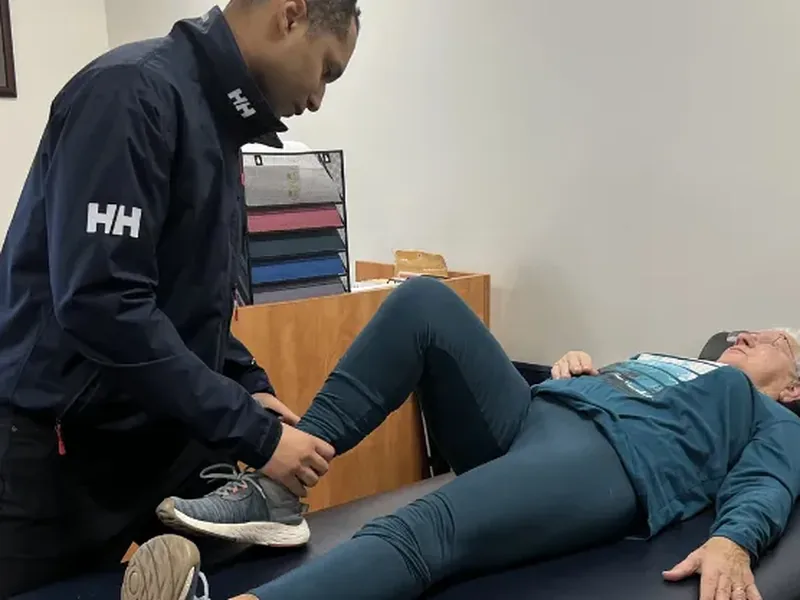
Doctor of Physical Therapy working one on one with a patient
01What It Is

What is spinal manipulation?

Spinal manipulation is a high-velocity, low-amplitude thrust delivered to one specific spinal or extremity joint. High velocity means fast. Low amplitude means the distance travelled is very small, often only a few millimetres. Those two things together are what separate a manipulation from a wrench or a twist. Your therapist takes the joint to the end of its available range, sets a precise line of force, and applies a short quick thrust along it. The familiar pop is cavitation, gas coming out of solution in the joint fluid, and it is a byproduct rather than the purpose. What matters is what follows: the joint travels further, the muscles guarding it let go, and the nervous system stops treating that segment as a threat. Dr. Michael Brown holds postdoctoral training in manual therapy for spinal and extremity joint manipulation, so the decision of whether to manipulate, where, and in which direction comes out of a full examination rather than out of wherever you happen to hurt.

Manipulation is fast, but it is not a shortcut. It buys a window in which a stiff segment moves and a guarded muscle relaxes, and what you do inside that window decides whether the change holds. That is why every manipulation here is followed by exercise that teaches the region to keep its new position. Massachusetts direct access lets you book without a physician referral. Some plans still require one for coverage, so we verify your benefits before your first visit and tell you exactly where you stand.

02Who It's For

Who is spinal manipulation in Plymouth for?

Manipulation suits joint restriction that is mechanical, local, and reproducible: a segment that will not move, in a spine that is otherwise healthy. It is not something we apply to every back. Whether it is right for you gets decided at the evaluation, not before it.

01

A back that locked up and has not let go

You bent to pull a bag out of the trunk and something in your low back seized. A week later the sharp pain has faded, but the segment is still stuck and bending or twisting hits a hard stop. A targeted thrust often frees that motion in a single session, and the exercise that follows is what keeps it free.

02

A mid-back that will not rotate

Golf, tennis, and simply looking over your shoulder all ask your mid-back to twist, and yours has stopped. So the shoulder and the low back rotate extra to cover the difference and take the punishment for it. Manipulation restores rotation where it belongs, which usually quiets the joints that had been covering.

03

A neck that aches by every afternoon

By three o'clock your neck aches and the base of your skull feels tight. Massage helps until tomorrow. When the driver is a restricted segment rather than tight muscle, manipulation paired with targeted strengthening tends to hold. Your therapist screens the neck carefully first, because not every stiff neck is a candidate.

03What To Expect

What happens in a manipulation session?

Nothing about this should come as a surprise while it is happening. Here is the order a session runs in, from the exam to the work that makes the change stick.

01

The examination comes first

Your first visit is a 30 to 60 minute hands-on evaluation, one on one with a Doctor of Physical Therapy. Before anything is manipulated, your therapist screens you: how you move, where the restriction actually sits, and whether anything in your history rules a thrust out. Manipulation is a decision, not a default. If the exam says graded mobilization or soft tissue work is the better tool that day, that is what you get.

02

The thrust itself

You are positioned so the target joint sits at the end of its range with everything around it supported. Your therapist takes up the slack, tells you what is coming, and asks you to breathe out. The thrust is quick and very small. Most people describe pressure and a release rather than pain. You may hear a pop and you may not, and neither one tells you whether it worked. Your therapist rechecks the motion straight afterward, and that does.

03

Locking in the change

A joint that has just started moving needs a reason to keep moving, so the rest of the session goes to exercise that loads the new range, plus a short home program. Most patients notice improvement within about six visits, and typical care runs two to three visits a week for four to six weeks. We accept nine major carriers including Aetna, Blue Cross Blue Shield and Medicare, along with Workers' Compensation and auto injury claims, and self-pay rates are available.

Safety and contraindications

Manipulation is not for everyone and is never applied without screening first. Tell your therapist if you have osteoporosis, a known or suspected fracture, inflammatory arthritis, a spinal fusion or hardware, or cancer, or if you take a blood thinner. Report any dizziness, visual changes, trouble swallowing, or numbness in both hands before treatment. Mild soreness or a stiff feeling for a day afterward is normal. Sharp pain, radiating numbness, or dizziness during the technique is not. Tell your therapist to stop and it stops.

In Their Words
My experience was very positive. Jake was very focused on developing a treatment plan for my lower back, that addressed my PT needs both at the clinic and home. The results were fantastic!
Antonio S. · Google review
Explore More

Where to go next.

Request an Appointment

Ready when you are.

HoursMon-Thu: 7:20am - 6:00pm | Fri: 7:20am - 1:00pm
Walk-insCall ahead
Book your evaluation. No referral needed in Massachusetts.
Step 1 of 5
First things first. What's your name?
We'll need a name to book you in.
Best number to reach you?
A phone number lets us confirm same-day.
And your email?
We'll send your confirmation here.
What questions do you have about your pain or injury?
A few words is all we need.
Look right? Send it.
✓
Request received.

We'll call within business hours to lock in your time.

Book Now · Schedule Appointment