(508) 682-4217 · 715 State Rd, Plymouth, MA 02360
Maritime Physical Therapy

Chronic Pain Treatment in Plymouth

Chronic pain takes over your life because your nervous system learns to amplify pain even when tissue is healing. Breaking that cycle requires patience and the right kind of movement.

01What Causes It

What causes chronic pain?

Chronic pain is rarely about tissue damage anymore. By the time pain lasts weeks or months, your nervous system has learned to amplify the signal, even if the original injury has healed. Understanding this is the key to recovery. You cannot force chronic pain away. You have to retrain the nervous system to turn the volume down.

Older man wincing in pain while holding his leg at home

When pain lasts long enough, your nervous system becomes hypervigilant. It starts detecting danger signals that were never there. Light touch feels painful. Normal movement feels threatening. The nervous system is protecting you too well. Retraining requires slow, safe movement that teaches the system the pain signal is not reliable. This is not imagined or exaggerated. It is a real change in how the nervous system processes signals, and it responds to gradual retraining.

An injury that was not fully rehabilitated leaves weakness and instability. Pain keeps flaring because the underlying damage was never fixed. Physical therapy addresses what was broken, not just what hurts. Plenty of people rested an injury until it stopped screaming and then went straight back to normal life, never rebuilding the strength, the range of motion or the tolerance for load that was lost along the way. That gap is what keeps flaring.

You protect an injured area by tensing around it. That tension was helpful at first. But weeks later, the constant guarding becomes its own source of pain. Breaking the guarding pattern means moving despite the fear, slowly and progressively, so your muscles learn they can relax again. Hands-on work earns its place here, because tissue that has been braced for months often responds to touch before it responds to exercise.

Stress hormones amplify pain signals. Poor sleep prevents healing and lowers pain tolerance. Anxiety about pain creates a vicious cycle. These factors are not separate from physical therapy. They are central to it. Movement, quality sleep, and managing stress are how the nervous system recalibrates. We do not hand these off as someone else's problem. They get built into the plan alongside the exercise.

Avoiding movement to prevent pain works short-term. Long-term, it makes things worse. Your muscles weaken, your joints stiffen, and your confidence in movement disappears. Pain actually increases because your body can no longer handle normal activity. Gradual reintroduction of movement is the antidote. Capacity usually returns faster than people expect once the reintroduction is graded carefully rather than guessed at week to week.
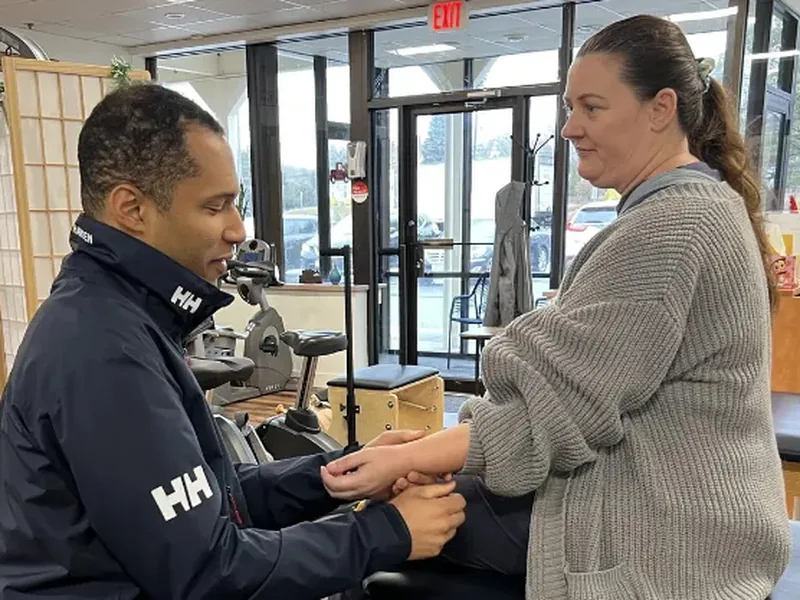

Physical therapist performing hands-on soft tissue treatment at Maritime Physical Therapy
02How PT Helps

How physical therapy in Plymouth helps.

Chronic pain rehab is about recalibrating your nervous system through progressive, purposeful movement. We start by understanding your pain pattern, what makes it worse, and what you have stopped doing. Then we build a plan that gradually reintroduces movement and activity, always at a level where your nervous system feels safe. This is not about pushing through pain. It is about moving in a way that convinces your nervous system there is no threat. As you improve, we add strength, range of motion, and real-world activities. The goal is not just pain relief. It is restoration of function, return to the activities you value, and the confidence that pain does not control your life anymore.

Education is as important as any exercise we prescribe. Understanding why pain persists even after tissue has healed takes away much of its power, because fear and uncertainty are what keep the nervous system on high alert. We walk through what is actually happening in your body so the plan makes sense rather than guesswork. Progress rarely moves in a straight line, so a difficult week is not a failure. What matters most is the overall trend, and staying consistent with movement even when a flare shows up.

You do not need a physician referral to start. Massachusetts has direct access to physical therapy, and some insurance plans still require a referral for coverage, so we verify your benefits before your first visit and tell you exactly where you stand. We accept Aetna, ASHLink, Blue Cross Blue Shield, Cigna, Fallon Health, Harvard Pilgrim, Mass General Brigham Health Plan, Medicare and Tricare, along with Workers' Compensation and auto injury claims, and flat self-pay rates are available if you are not covered. Sessions run 30 to 60 minutes, one on one with your doctor of physical therapy.

03What To Expect

What to expect from your recovery.

01

Understanding and pain management

We start by understanding how your pain works. Early sessions use techniques to reduce pain and teach your nervous system that your body is not in danger. You leave knowing why you hurt and what actually helps. This clarity alone often reduces the anxiety around movement before any real exercise even begins. Most patients notice improvement within about six visits, and typical care runs two to three visits a week for four to six weeks.

02

Progressive movement and reconditioning

We gradually reintroduce activities you have avoided. This is done slowly and carefully, at a pace where your nervous system trusts that movement is safe. Each week, your tolerance grows. Setbacks along the way are expected and get folded into the plan. A flare is information about dosage, not evidence that the plan failed.

03

Return to full function and confidence

As pain decreases and strength returns, you resume the activities that define your life. You learn to manage pain on your own, with the tools to handle an occasional flare instead of feeling derailed by it. You leave with a written home program and a clear plan for the next difficult week.

In Their Words
My experience was very positive. Jake was very focused on developing a treatment plan for my lower back, that addressed my PT needs both at the clinic and home. The results were fantastic!
Antonio S. · Google review
Related Conditions

Pain rarely travels alone.

Request an Appointment

Ready when you are.

HoursMon-Thu: 7:20am - 6:00pm | Fri: 7:20am - 1:00pm
Walk-insCall ahead
Book your evaluation. No referral needed in Massachusetts.
Step 1 of 5
First things first. What's your name?
We'll need a name to book you in.
Best number to reach you?
A phone number lets us confirm same-day.
And your email?
We'll send your confirmation here.
What questions do you have about your pain?
A few words is all we need.
Look right? Send it.
✓
Request received.

We'll call within business hours to lock in your time.

Book Now · Schedule Appointment