The surgery is behind you. The knee is swollen, the leg feels like it belongs to someone else, and nothing about walking is automatic yet. Recovery after a total knee is earned in a specific order, and we know that order.
A knee replacement takes care of the arthritic joint. It does not hand back the motion, the quad strength, or the confidence that had been fading for years before the operation. That part is rehab, and these are the things that most often get in its way.
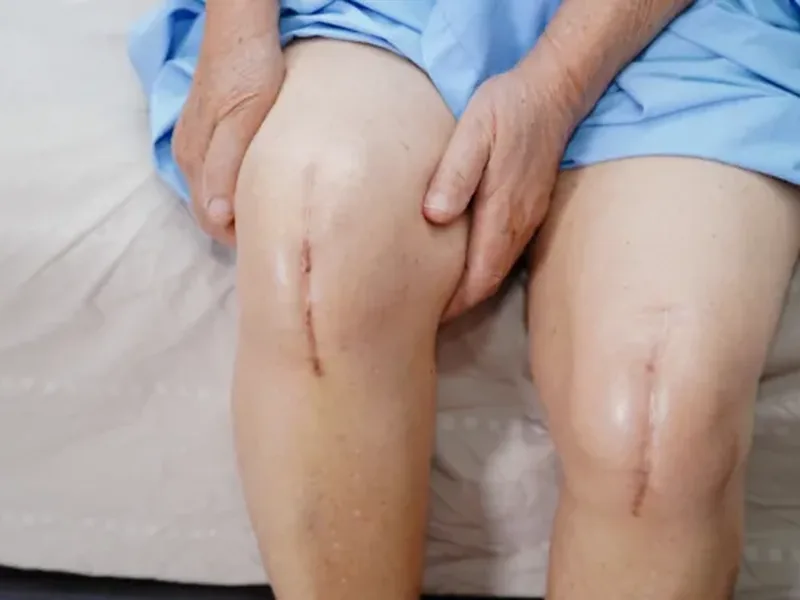
Swelling is expected after a knee replacement, and it is also the main reason the quadriceps will not fire in the early weeks. A joint holding fluid reflexively inhibits the muscle around it, which is why the leg can feel disconnected even when you are trying your hardest. Elevation, gentle repeated motion, compression as your surgeon advises, and specific quad activation work all give the muscle a way back in. Chasing heavy strengthening while the knee is very swollen tends to disappoint.
Of everything we track after a total knee, full extension matters most for walking. A knee that rests a few degrees short makes the quad work every second you are upright, tires the leg quickly, and leaves you with a limp. It is also the range that disappears fastest if you spend your days with a pillow tucked under the knee. Early positioning and specific extension work protect it, and getting it back later is far harder than keeping it now.
Flexion is the range you need for stairs, for a car seat, for standing up out of a low chair. It returns through repeated, tolerable movement rather than one heroic push, and it is usually uncomfortable to work on. How far and how fast is set by your surgeon's protocol, not by a number you read online. We work to the range you have been cleared for, measure it every visit, and tell you honestly where you stand.
Most people limped for a year or more before the operation. In that time the quad shrinks, the glute stops contributing, and the other leg quietly takes over the work. A new joint does not undo any of that. Rebuilding takes deliberate strengthening on both sides, hip included, because a knee supported by a weak hip keeps getting loaded badly. This is the phase that turns a knee which no longer hurts into a leg you actually trust.
Late recovery is not only strength, it is willingness. Stepping down onto the operated leg asks it to lower your whole body under control, and plenty of people avoid that for months without realising it. Add a curb, a wet floor, or a crowded room and the caution grows. We train stairs, step downs, walking speed and balance on purpose, so that getting around stops being something you have to think about first.
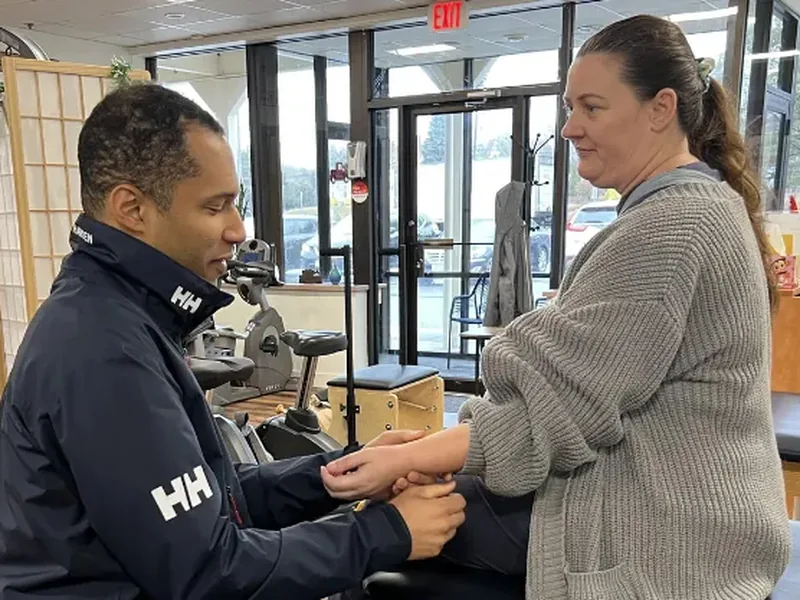

Recovery after a total knee follows an order: motion first, then strength, then walking and stairs you do not have to think about. Skip a step and the next one stalls. Your surgeon's protocol sets the boundaries, including weight bearing and the range you are cleared for, and we work inside it rather than around it. Within those limits we get after it. Hands-on work to free the kneecap and the healing scar, manual stretching for extension and flexion, and progressive strengthening for the quad, hamstrings and hip. You do not need a physician referral to book with us, because Massachusetts has direct access to physical therapy, and where a plan still requires one for coverage we verify your benefits before your first visit. Every session is one on one, so nobody is left counting reps alone in the corner.
Your first visit runs 30 to 60 minutes, one on one with a doctor of physical therapy. We measure the knee's range in both directions, check the swelling and the incision, watch you walk and take a stair, and read your surgeon's protocol so the plan matches it. You leave knowing your numbers, what we are working on first, and exactly what to do at home between visits.
Then we chase range while the quad wakes back up. Hands-on mobilization for the kneecap and scar, manual work for straightening, and repeated bending that stays inside what you can tolerate. The money question gets answered early too: we accept nine major carriers, along with Workers' Compensation and auto injury claims, we verify your benefits and give you your copay in writing, and flat self-pay rates are available.
As the range returns, strength leads. Quads, glutes, hamstrings and balance, then stairs, curbs and walking distance. Most patients notice improvement within about six visits, and a typical plan runs two to three visits a week for four to six weeks, reassessed as you go. Recovery from a total knee keeps developing past that, and we will tell you honestly where you are rather than promise a date.
I highly recommend working with Jake at Maritime PT. He is very knowledgeable and in just a couple of sessions I am seeing improvement.

The other big joint, the same order of operations. Motion, then strength, then walking you trust.

The arthritis that led you to surgery often lives in other joints too. Loading them well is the treatment.

A limp can outlive the surgery unless it gets retrained. We work on walking, curbs and steadiness.